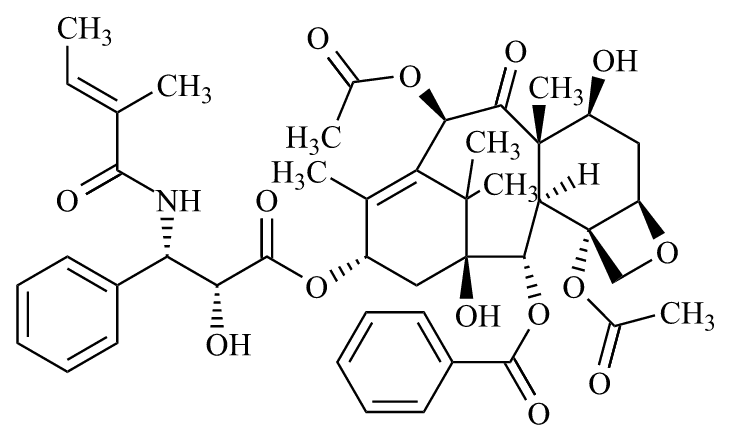
Paclitaxel is a taxane-class chemotherapeutic agent widely used to treat solid tumors, including ovarian, breast, lung, and bladder cancers, as well as Kaposi’s sarcoma. It functions by binding to the… Read more


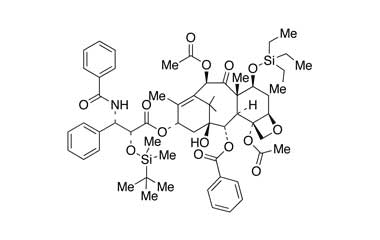
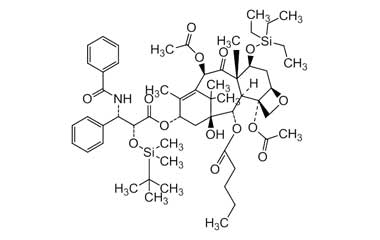
![Chemical structure of 7-O-(Triethylsilyl)-2'-O-tert-butyl(dimethyl)silyl-4-desacetyl-2-debenzoyl-[2,4]oxol Paclitaxel](/_next/image?url=https%3A%2F%2Fassets.splendidlab.com%2F160768-75-2-7-O-Triethylsilyl-2-O-tert-butyldimethylsilyl-4-desacetyl-2-debenzoyl-24oxol-Paclitaxel.png&w=3840&q=75)


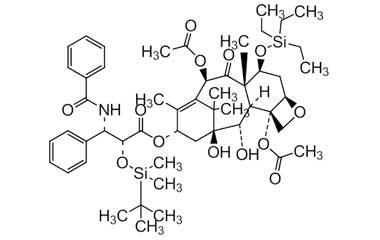
![Chemical structure of 7-{[(2,2,2,-Trichloroethyl)oxy]carbonyl} Baccatin III](/_next/image?url=https%3A%2F%2Fassets.splendidlab.com%2F103150-33-0-7-222-Trichloroethyloxycarbonyl-Baccatin-III.png&w=3840&q=75)
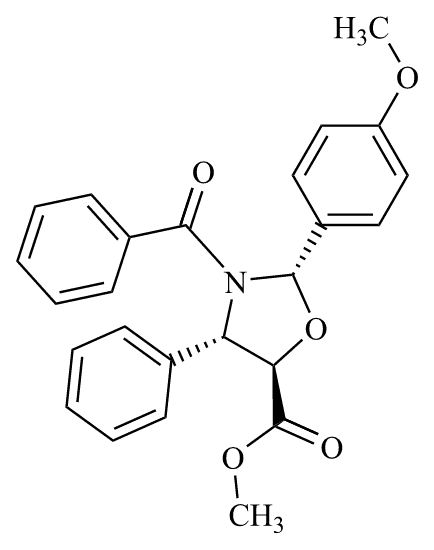
![Chemical structure of 7-{[(2,2,2,-Trichloroethyl)oxy]carbonyl} Baccatin III (4S, 5S)-3-Benzoyl-2-(4-methoxyphenyl)-4-phenyl-5-oxazolidinecarboxylate](/_next/image?url=https%3A%2F%2Fassets.splendidlab.com%2F1033574-06-9-7-222-Trichloroethyloxycarbonyl-Baccatin-III-4S-5S-3-Benzoyl-2-4-methoxyphenyl-4-phenyl-5-oxazolidinecarboxylate.png&w=3840&q=75)
![Chemical structure of 7-{[(2,2,2,-Trichloroethyl)oxy]carbonyl} Paclitaxel](/_next/image?url=https%3A%2F%2Fassets.splendidlab.com%2F114915-17-2-7-222-Trichloroethyloxycarbonyl-Paclitaxel.png&w=3840&q=75)

![Chemical structure of [1,1':3',1''-terphenyl]-2'-ol](/_next/image?url=https%3A%2F%2Fassets.splendidlab.com%2F2432-11-3-1131-terphenyl-2-ol.png&w=3840&q=75)


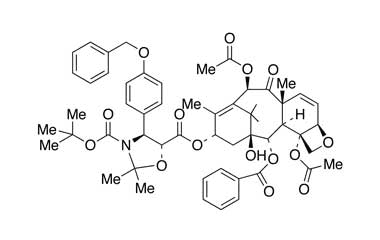
![Chemical structure of N-Debenzoyl-3'-p-O-benzy-7-{[(2,2,2,-trichloroethyl)oxy]carbonyl} Paclitaxel](/_next/image?url=https%3A%2F%2Fassets.splendidlab.com%2FN-Debenzoyl-3-p-O-benzy-7-222-trichloroethyloxycarbonyl-Paclitaxel.png&w=3840&q=75)

![Chemical structure of N-Debenzoyl-7-{[(2,2,2,-trichloroethyl)oxy]carbonyl} Paclitaxel](/_next/image?url=https%3A%2F%2Fassets.splendidlab.com%2F114915-15-0-N-Debenzoyl-7-222-trichloroethyloxycarbonyl-Paclitaxel.png&w=3840&q=75)


Paclitaxel is a taxane-class chemotherapeutic agent widely used to treat solid tumors, including ovarian, breast, lung, and bladder cancers, as well as Kaposi’s sarcoma. It functions by binding to the β-tubulin subunit, stabilizing microtubules and inhibiting their depolymerization, which effectively arrests the cell cycle and induces apoptosis in rapidly dividing cancer cells. Pharmaceutical laboratories utilize this category of compounds, including structural impurities, metabolites, and stable isotope labelled standards, to ensure rigorous quality control and regulatory compliance. Impurities are essential for impurity profiling and the development of validated analytical methods to detect degradation products. Meanwhile, stable isotope labelled compounds serve as vital internal standards in mass spectrometry, facilitating precise quantification and the study of drug metabolism. These reference standards enable laboratories to maintain the highest levels of accuracy during analytical testing and routine drug substance characterization.