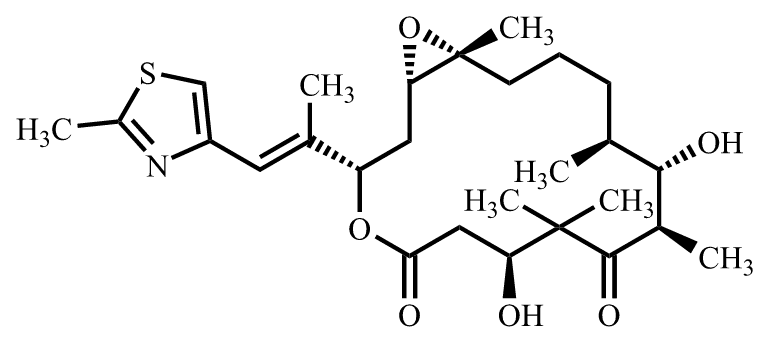
Epothilone B is a cytotoxic 16-membered macrolide that functions as a microtubule-stabilizing agent, mirroring the mechanism of action of taxanes by binding to tubulin and inhibiting cell division in the… Read more
![Chemical structure of (3S,6R,7S,12Z,15S,16E)-3,7-Bis-{[tert-butyl(dimethyl)silyl]oxy}-15-hydroxy-4,4,6,8,12,16-hexamethyl-17-(2-methyl-1,3-thiazol-4-yl)-5-oxoheptadeca-12,16-dienoic Acid](/_next/image?url=https%3A%2F%2Fassets.splendidlab.com%2F193146-26-8-3S6R7S12Z15S16E-37-Bis-tert-butyldimethylsilyloxy-15-hydroxy-44681216-hexamethyl-17-2-methyl-13-thiazol-4-yl-5-oxoheptadeca-1216-dienoic-A.png&w=3840&q=75)
![Chemical structure of (3S,6R,7S,8S,12Z,15S,16E)-1,3,7,15-Tetrakis-{[tert-butyl(dimethyl)silyl]oxy}-4,4,6,8,12,16-hexamethyl-17-(2-methyl-1,3-thiazol-4-yl)heptadeca-12,16-dien-5-one](/_next/image?url=https%3A%2F%2Fassets.splendidlab.com%2F193146-51-9-3S6R7S8S12Z15S16E-13715-Tetrakis-tert-butyldimethylsilyloxy-44681216-hexamethyl-17-2-methyl-13-thiazol-4-ylheptadeca-1216-dien-5-one.png&w=3840&q=75)
![Chemical structure of (4S,7R,8S,9S,13Z,16S)-4,8-Bis-{[tert-butyl(dimethyl)silyl]oxy}-5,5,7,9,13-pentamethyl-16-[(E)-1-methyl-2-(2-methyl-1,3-thiazol-4-yl)ethenyl]oxocyclohexadec-13-ene-2,6-dione](/_next/image?url=https%3A%2F%2Fassets.splendidlab.com%2F189453-35-8-4S7R8S9S13Z16S-48-Bis-tert-butyldimethylsilyloxy-557913-pentamethyl-16-E-1-methyl-2-2-methyl-13-thiazol-4-ylethenyloxocyclohexadec-13-ene-.png&w=3840&q=75)
![Chemical structure of 4-[(1E,3S,5Z,8R/S,10S)-3,11-Bis-{[tert-butyl(dimethyl)silyl]oxy}-2,6,10-trimethyl-undeca-1,5-dienyl]-2-methyl-1,3-thiazole](/_next/image?url=https%3A%2F%2Fassets.splendidlab.com%2F210690-85-0-4-1E3S5Z8RS10S-311-Bis-tert-butyldimethylsilyloxy-2610-trimethyl-undeca-15-dienyl-2-methyl-13-thiazole.png&w=3840&q=75)

Epothilone B is a cytotoxic 16-membered macrolide that functions as a microtubule-stabilizing agent, mirroring the mechanism of action of taxanes by binding to tubulin and inhibiting cell division in the M phase. Investigated primarily for its potential in treating various solid tumors, including breast and ovarian cancers, this compound requires rigorous analytical oversight during pharmaceutical development. The accompanying reference standards, synthetic impurities, and metabolites—such as Epothilone D—provide the essential materials needed for precise impurity profiling and method validation. Laboratories utilize these high-purity substances, along with stable isotope-labelled compounds, to develop sensitive chromatographic methods and support high-resolution mass spectrometry analysis. These tools are critical for establishing robust quality control protocols, ensuring the accurate identification and quantification of related substances and degradants throughout the manufacturing and stability testing of this complex macrolide therapeutic.