Ertugliflozin is a sodium-glucose cotransporter 2 (SGLT2) inhibitor, a class of medication commonly referred to as gliflozins, used to manage type 2 diabetes mellitus either as a monotherapy or in combination… Read more
![Chemical structure of (1R,2S,3S,4R,5R)-5-(4-Chloro-3-(4-ethoxybenzyl)phenyl)-1-(hydroxymethyl)-6,8-dioxabicyclo[3.2.1]octane-2,3,4-triol](/_next/image?url=https%3A%2F%2Fassets.splendidlab.com%2F1R2S3S4R5R-5-4-Chloro-3-4-ethoxybenzylphenyl-1-hydroxymethyl-68-dioxabicyclo3.2.1octane-234-triol.png&w=3840&q=75)
![Chemical structure of (1S,2S,3S,4R,5S)-5-(4-Chloro-3-((4-ethoxyphenyl)(hydroxy)methyl)phenyl)-1-(hydroxymethyl)-6,8-dioxabicyclo[3.2.1]octane-2,3,4-triol](/_next/image?url=https%3A%2F%2Fassets.splendidlab.com%2F1298086-28-8-1S2S3S4R5S-5-4-Chloro-3-4-ethoxyphenylhydroxymethylphenyl-1-hydroxymethyl-68-dioxabicyclo3.2.1octane-234-triol.png&w=3840&q=75)
![Chemical structure of (1S,2S,3S,4R,5S)-5-(4-Chloro-3-(4-(2-hydroxyethoxy)benzyl)phenyl)-1-(hydroxymethyl)-6,8-dioxabicyclo[3.2.1]octane-2,3,4-triol](/_next/image?url=https%3A%2F%2Fassets.splendidlab.com%2F1298086-24-4-1S2S3S4R5S-5-4-Chloro-3-4-2-hydroxyethoxybenzylphenyl-1-hydroxymethyl-68-dioxabicyclo3.2.1octane-234-triol.png&w=3840&q=75)
![Chemical structure of (1S,2S,3S,4R,5S)-5-(4-Chloro-3-(4-hydroxybenzyl)phenyl)-1-(hydroxymethyl)-6,8-dioxabicyclo[3.2.1]octane-2,3,4-triol](/_next/image?url=https%3A%2F%2Fassets.splendidlab.com%2F1298086-17-5-1S2S3S4R5S-5-4-Chloro-3-4-hydroxybenzylphenyl-1-hydroxymethyl-68-dioxabicyclo3.2.1octane-234-triol.png&w=3840&q=75)
![Chemical structure of (1S,2S,3S,4S,5S)-5-(4-Chloro-3-(4-ethoxybenzyl)phenyl)-1-(hydroxymethyl)-6,8-dioxabicyclo[3.2.1]octane-2,3,4-triol](/_next/image?url=https%3A%2F%2Fassets.splendidlab.com%2F1210344-58-3-1S2S3S4S5S-5-4-Chloro-3-4-ethoxybenzylphenyl-1-hydroxymethyl-68-dioxabicyclo3.2.1octane-234-triol.png&w=3840&q=75)


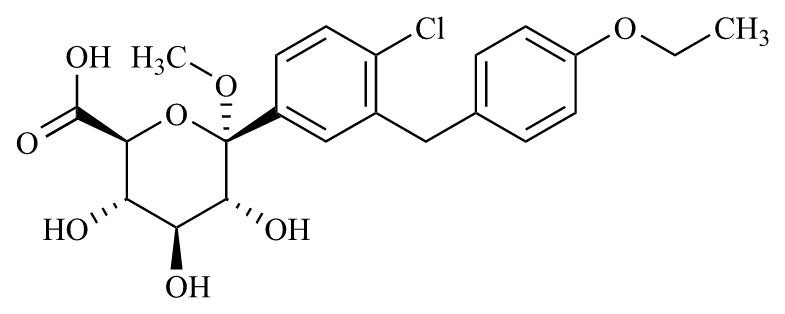
Ertugliflozin is a sodium-glucose cotransporter 2 (SGLT2) inhibitor, a class of medication commonly referred to as gliflozins, used to manage type 2 diabetes mellitus either as a monotherapy or in combination regimens. The analytical assessment of this active pharmaceutical ingredient requires a comprehensive suite of high-quality reference standards. Laboratories utilize these materials, including process-related impurities, degradation products, synthetic intermediates, and specific metabolites, for rigorous impurity profiling and method validation. Stable isotope labelled versions of the drug serve as critical internal standards for accurate quantification in mass spectrometry-based assays. Researchers rely on these well-characterized substances to perform forced degradation studies, genotoxicity assessments, and routine quality control, ensuring that the development and manufacturing processes meet strict regulatory standards for patient safety and therapeutic efficacy throughout the drug product lifecycle.